Some of the tastiest wild mushrooms share the forest with species that can make you very sick—or worse. Knowing the differences is not optional. This guide walks through seven sought-after edibles and the key look-alikes you must learn alongside them.
Introduction: When Good Mushrooms Have Bad Neighbors
Use this as a starting map, then dive deeper with regional field guides.
Warning: This article is educational, not a substitute for in-person training or multiple authoritative references. Never eat a mushroom based solely on an online description.
1. Morels vs. False Morels
True Morels (Morchella spp.) – Choice Edibles
Key ID features:
- Honeycomb-like cap with deep pits and ridges
- Cap is fully attached to the stem at the base (no skirt)
- Hollow from tip of cap through the stem when sliced lengthwise
- Colors range from tan to dark brown depending on species and age
- Found in spring, often near ash, elm, apple, and recently burned areas
False Morels (Gyromitra, Verpa spp.) – Potentially Deadly
Danger signs:
- Cap looks wrinkled, lobed, or brain-like rather than neat pits and ridges
- Cap may hang freely like a skirt (especially Verpa)
- Stem often filled with cottony or chambered tissue, not cleanly hollow
- Some contain gyromitrin, a toxin affecting liver and nervous system
Mentor tip: Always slice lengthwise. If it’s not completely hollow, do not eat it.
2. Chanterelles vs. Jack-o’-Lanterns
Chanterelles (Cantharellus spp.) – Choice Edibles
ID checklist:
- Thick, fleshy, often vase-shaped mushrooms
- Underside has false gills: blunt, forked ridges that are shallow and run down the stem
- Fruity, apricot-like scent
- Colors yellow to orange; grow singly or scattered on forest floors, not from wood
- Common from summer into fall, often with oaks, beeches, or conifers
Jack-o’-Lanterns (Omphalotus spp.) – Toxic
Danger signs:
- Grows in tight clusters from wood or buried roots
- Underside has true gills: sharp, blade-like, densely packed
- Can glow faintly in the dark (bioluminescent gills, though hard to see)
- Causes severe gastrointestinal distress
Mentor tip: If it’s emerging from wood in a dense cluster, and gills are sharp and blade-like, walk away.
3. Oysters vs. Angel Wings and Look-Alike Clusters
Oyster Mushrooms (Pleurotus spp.) – Good Edibles
ID checklist:
- Shelf-like caps, white to gray, tan, or even lilac/blue in some varieties
- Decurrent gills running down an off-center or nearly absent stem
- Growing on hardwood logs or stumps (oak, beech, maple)
- Pleasant, mild to anise-like odor
Angel Wings (Pleurocybella porrigens) – Suspect/Toxic
Danger signs:
- Very thin, delicate, pure white caps
- Most often on conifer wood
- Associated with poisonings in some countries
Other White Clusters – Potentially Dangerous
There are several white or pale gilled mushrooms that cluster on wood or soil and can be toxic.
Mentor tip: Until you’re truly confident, limit yourself to robust, colored oysters on hardwood, and skip thin, fragile white shelves entirely.
4. Meadow Mushrooms vs. White Death Caps & Destroying Angels
Meadow Mushrooms (Agaricus campestris group) – Edibles with Caveats
ID checklist:
- Gills start pink, turn chocolate brown with age
- Spore print dark brown
- No volva at base
- Grows in grasslands, meadows, lawns (be cautious of pesticides)
Destroying Angels & Death Caps (Amanita spp.) – Deadly
Danger signs:
- Gills remain white throughout life
- Spore print white
- Presence of a volva: saclike cup at base of stem (often buried, must dig deeply)
- Often has a ring (annulus) and a smooth white or pale cap (death caps may be greenish)
- Contains amatoxins—tiny amounts can cause liver failure
Mentor tip: If you are new, avoid all white, gilled mushrooms with white spores. The risk isn’t worth it.
5. Puffballs vs. Deadly Amanita Buttons
True Puffballs (Lycoperdon, Calvatia spp.) – Some Good Edibles When Young
ID checklist:
- No visible cap, gills, or stem when young
- Round or pear-shaped, attached directly to substrate
- When sliced cleanly in half: uniform, solid white interior, like a marshmallow
Amanita Buttons – Deadly Risk
Young Amanitas can appear as white "eggs" before the cap and stem emerge.
Danger signs when sliced:
- Visible developing cap, gills, and stem inside the "egg"
- They are larger than a golf ball (micropuffballs are not worth the risk), and
- When sliced in half, they are completely solid white inside with no sign of internal structures.
Mentor tip: Only eat puffballs if:
Anything else goes back to the forest.
6. Chicken of the Woods vs. Look-Alikes and Bad Hosts
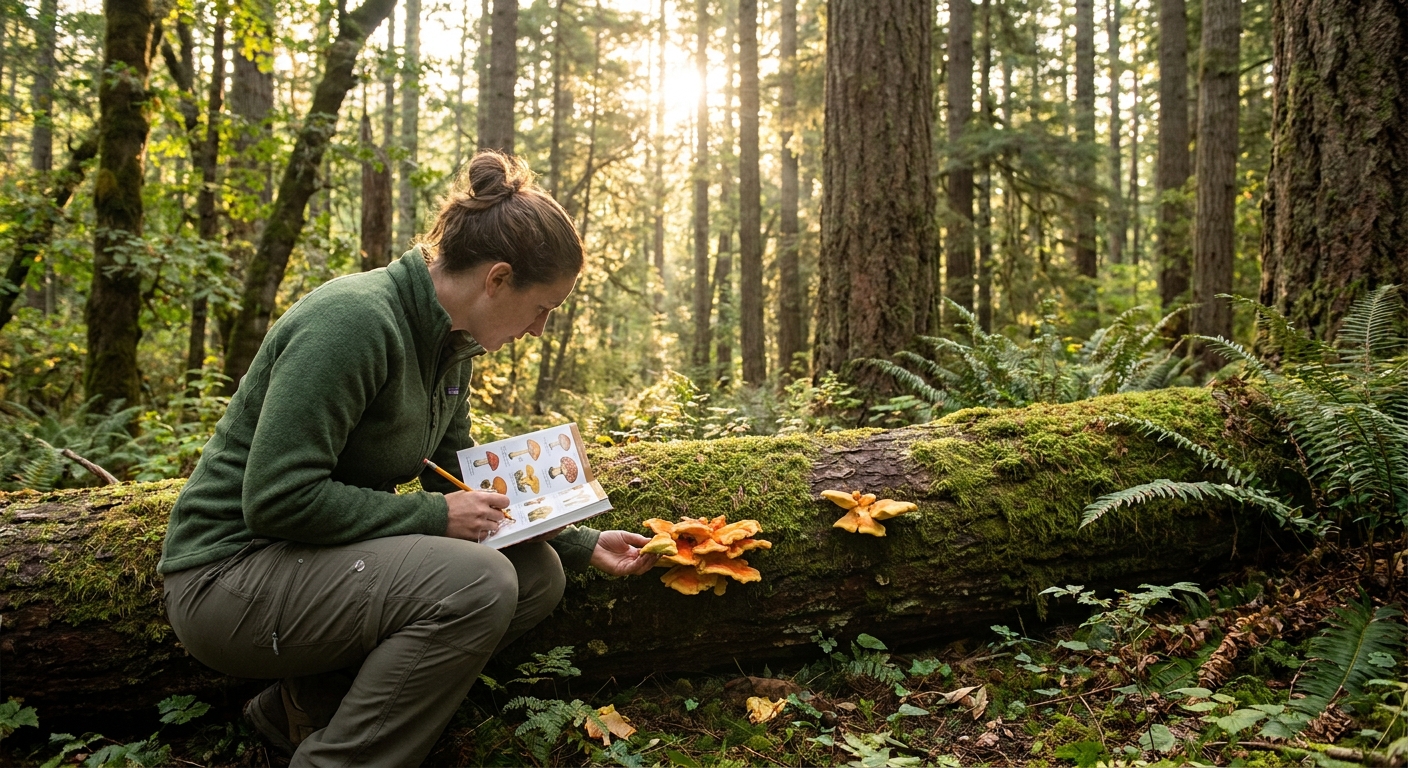
Chicken of the Woods (Laetiporus spp.) – Popular Edible, With Caveats
ID checklist:
- Bright yellow to orange shelves, often overlapping in clusters
- Grows on trees or stumps; often oaks in many regions
- Flesh is thick, soft when young, becomes crumbly and chalky when old
- Mild to lemony scent; texture similar to chicken when cooked
Cautions and Confusions
- On conifers or eucalyptus, some people report more reactions—avoid these if you’re cautious.
- Very old, dry, or bug-riddled specimens can cause gastrointestinal upset.
- Some other polypores can be orange-ish but lack the soft, juicy young texture of true chicken.
Mentor tip: Only harvest from hardwoods, choose tender young shelves, and test a small cooked portion first.
7. Hen of the Woods vs. Black-Staining Polypore
Hen of the Woods / Maitake (Grifola frondosa) – Choice Edible
ID checklist:
- Large, multi-layered rosette of overlapping fronds
- Colors gray-brown to brown, undersides with tiny pores
- Base attached to hardwood (especially oak stumps and roots)
- Firm but not tough, with a rich umami aroma
- Appears in late summer through fall
Look-Alike: Black-Staining Polypore (Meripilus sumstinei) – Edible for Some, Tough
Key differences:
- Paler to whitish fronds that quickly blacken when bruised or handled
- May be more watery and less flavorful
- Often edible but can cause stomach upset in some people
Mentor tip: Learn to recognize the black-staining reaction. Even if it’s technically edible, many foragers skip it in favor of true maitake.
Safety Checklist Before Any Wild Mushroom Hits the Pan
- Identify to species using at least two reliable sources.
- Confirm habitat: right tree, right substrate, right season.
- Check multiple specimens: young, mature, and aging mushrooms all match.
- Do a spore print when relevant, especially for gilled mushrooms.
- Cut them open: look for internal structures, bugs, rot, or color changes.
- Cook thoroughly: many mushrooms are unsafe raw.
- Test cautiously: small portion first, especially with a new species.
Final Thoughts: Learn Pairs, Not Just Prizes
For every edible you chase, deliberately learn its primary look-alikes—including the toxic ones. This paired learning strategy builds a mental safety net: you don’t just recognize what you want; you also recognize what you must avoid.
Move slowly, stay humble, and let your caution grow as quickly as your curiosity. That balance is what turns mushroom hunting from a risky novelty into a safe, lifelong practice.