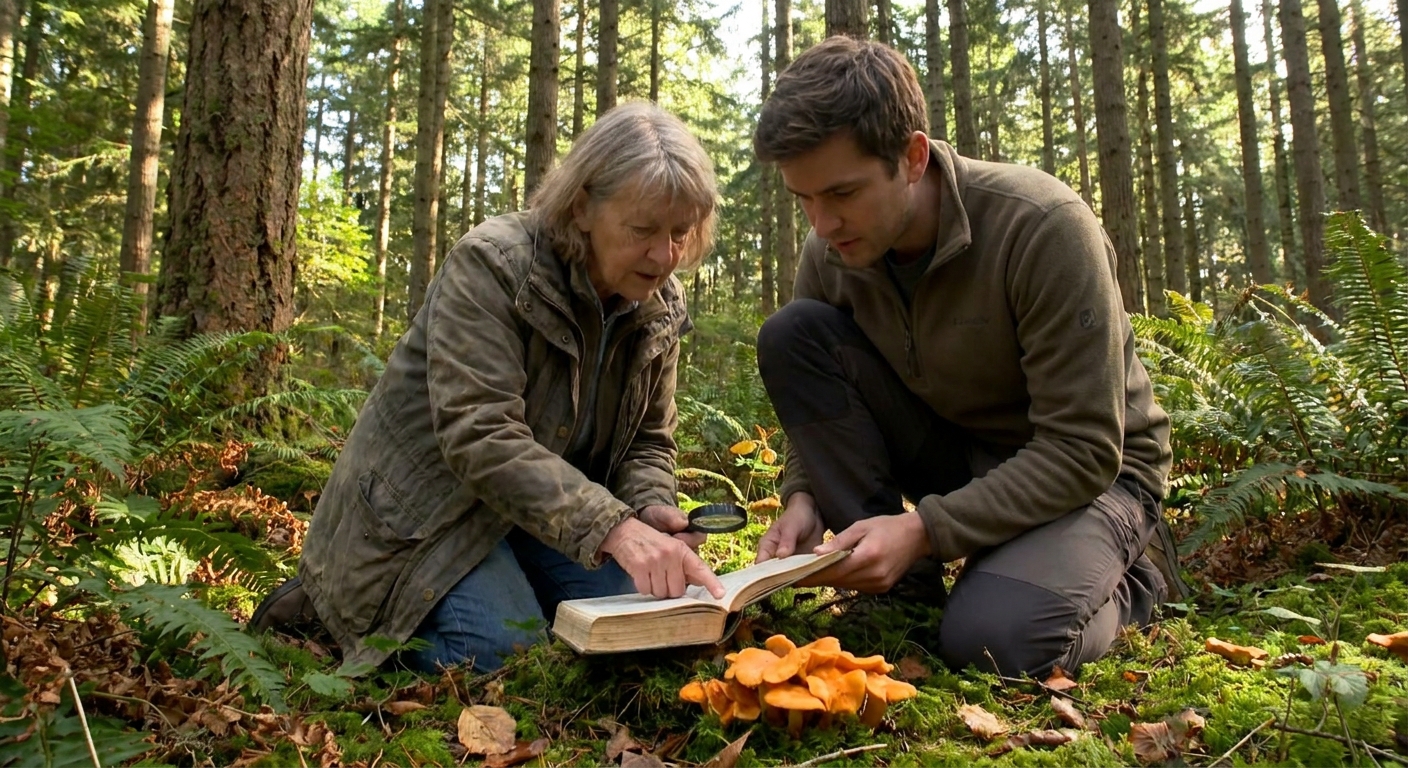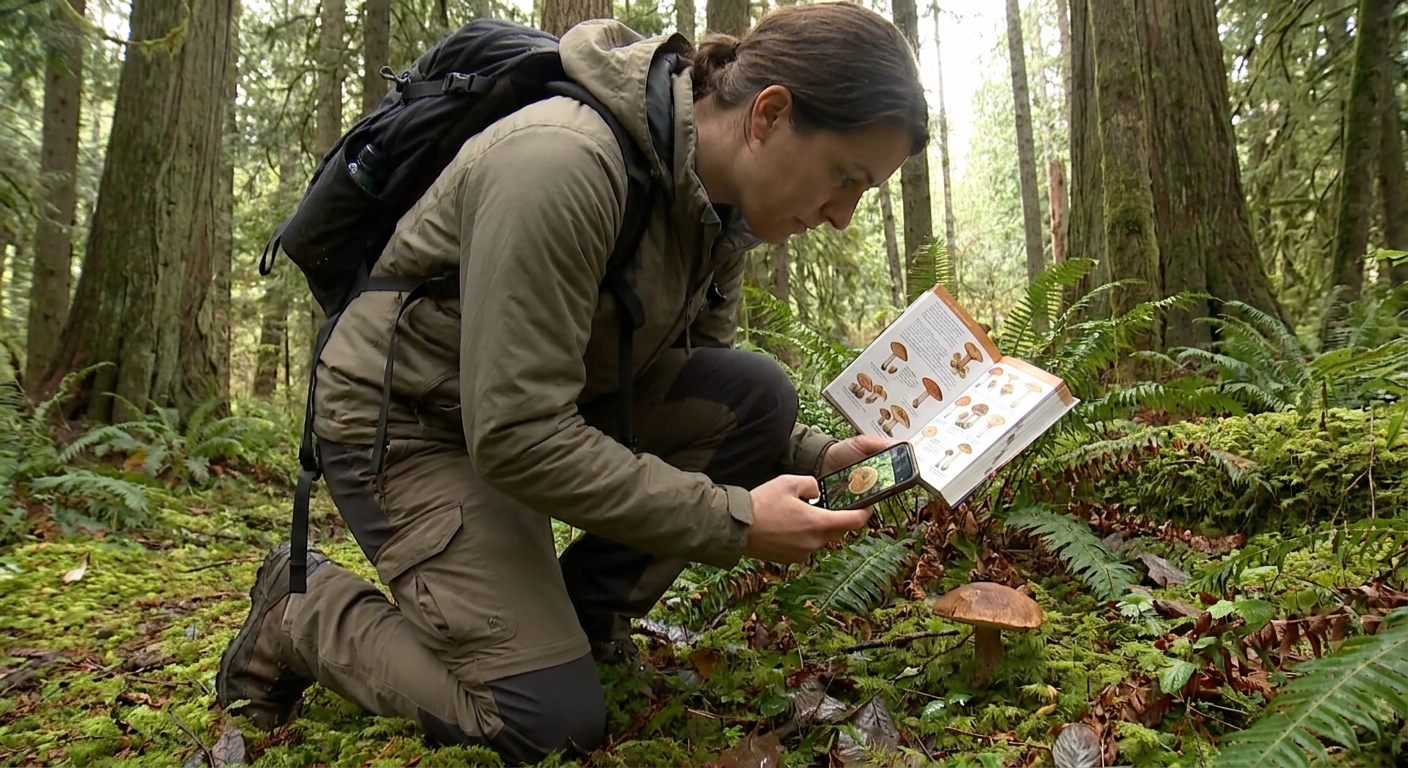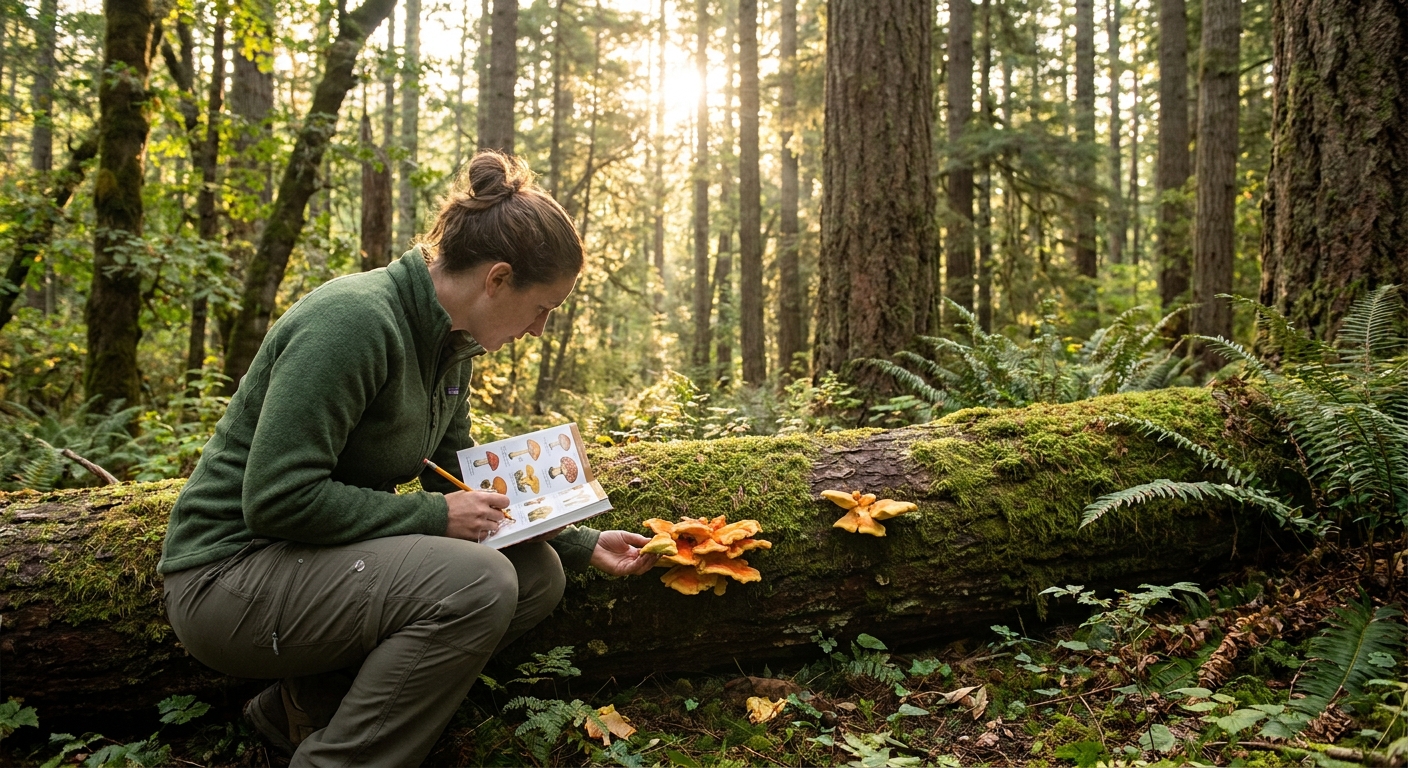
Before you chase gourmet mushrooms, it’s wise to first learn the common, easily recognized species groups in your area—edible, inedible, and toxic. Think of this as learning the alphabet before writing sentences.
Introduction: Learn the Forest’s Regulars Before You Forage Your Dinner
This list focuses on ten approachable groups that will teach you core ID skills: cap structures, gill types, substrates, and seasonal patterns. Some are edible, some are not; the goal here is familiarity, not filling your plate.
1. Turkey Tail and Its Look-Alikes (Wood Decayers)
Species: Primarily Trametes versicolor
Why it’s useful to learn:
- Ubiquitous on dead hardwood branches and logs.
- Teaches you to observe pore surfaces and zoned cap patterns.
- Thin, leathery brackets with concentric, multi-colored zones (brown, tan, gray, sometimes blue/green with algae).
- White to cream pore surface underneath, very small pores.
- Always on dead wood, often in layered rosettes.
- Several other Trametes and small polypores. Most are harmless but not necessarily useful. Learn to distinguish pore surfaces from gills.
Key ID features:
Look-alikes:
Season: Nearly year-round in many climates, especially visible in cooler months.
2. Birch Polypore (The Trailside Teacher)
Species: Fomitopsis betulina (formerly Piptoporus betulinus)
Why it’s useful to learn:
- Very specific to birch trees.
- Teaches tree association and host specificity.
- Hoof- or kidney-shaped, smooth tan to brown top.
- White pore surface that bruises slightly brown.
- Exclusively on dead or dying birch trunks.
- Thick, tough, inedible texture.
Key ID features:
Season: Found any time of year on birch in temperate regions.
3. Puffballs (White Marshmallows vs. Hidden Killers)
Genera: Lycoperdon, Calvatia, others
Why it’s useful to learn:
- Common in lawns, fields, forest edges.
- Teaches the critical habit of slicing mushrooms open.
- Ball- or pear-shaped; no distinct cap and stem when young.
- When sliced in half: should be uniform, solid white inside for safe-stage puffballs.
- Young deadly Amanitas can look like small white puffballs externally.
- If you see any developing cap, gills, or stem inside, it is not a puffball.
Key ID features:
Important warning:
Season: Late summer through fall in many regions.
4. Amanita Group (The Ones You Don’t Experiment With)
Genera: Amanita
Why it’s useful to learn:
- Contains some of the most deadly mushrooms on earth.
- Learning their hallmarks helps you avoid catastrophic mistakes.
- Classic cap-and-stem mushrooms, often with a ring (annulus) on the stem.
- Base of stem often enclosed in a volva (sac or cup) or features a bulb.
- White spore print.
- Destroying Angels (white Amanitas).
- Death Cap (Amanita phalloides), often pale greenish to yellowish cap.
Key ID features (general):
Notable dangerous species:
Mentor rule: Until you are truly advanced, treat all Amanitas as inedible, no matter what you’ve heard about "edible Amanitas." They are for study, not for dinner.
5. Shaggy Mane & Inky Caps (Ephemeral Storytellers)
Genera: Coprinus, Coprinellus, Coprinopsis
Why it’s useful to learn:
- Show dramatic changes: caps dissolving into black ink.
- Teaches about short-lived mushrooms and cap deliquescence.
- Tall, cylindrical white caps with shaggy, upturned scales.
- Caps expand and then dissolve into black liquid from the edges upward.
- Often in disturbed soils, lawns, and roadsides.
- Some inky caps interact with alcohol and cause illness.
- These are not ideal beginner edibles; focus on observing their lifecycle.
Shaggy Mane (Coprinus comatus) key ID:
Caution:
Season: Late summer to fall, sometimes after rain.
6. Russulas (The Crumbly Color Wheel)
Genus: Russula
Why it’s useful to learn:
- Very common and visually diverse; great for practicing gill and spore print observations.
- Brittle, chalky stems that snap like a piece of chalk.
- Caps come in many colors: red, green, yellow, purple, etc.
- White to pale spore prints.
- Some Russula species are edible, others cause stomach upset.
- Beginners should consider the whole group "for practice only" until they’re comfortable using more advanced keys.
Key ID features:
Edibility notes:
Season: Summer through fall, especially in mixed woods.
7. Milk Caps (Lactarius and the Art of Latex)
Genus: Lactarius (and some now in Lactifluus)
Why it’s useful to learn:
- Teaches you to test for latex (milk-like fluid), an important ID trait.
- Gilled mushrooms that exude colored latex when gills or flesh are cut or broken.
- Latex colors: white, clear, orange, red, or even blue-green in some species.
- Gently scratch the gills with a knife.
- Watch for latex color and any color change after a few minutes.
- Some are edible (like Lactarius deliciosus group), others are acrid or mildly toxic.
- For now, focus on learning the latex reaction as a diagnostic feature.
Key ID features:
How to observe:
Edibility notes:
Season: Summer to fall in forests.
8. Polypores on Conifers vs. Hardwoods
Why it’s useful to learn:
- Makes you pay attention to tree type, a critical ecological clue.
- Walk in mixed woods and note each polypore you see.
- Ask: Is it on hardwood (oak, maple, beech, birch) or conifer (pine, spruce, fir)?
- *Artist’s Conk (Ganoderma applanatum): large, brown, and white polypore often on hardwoods; underside can be scratched for drawings.
- Red Belted Conk (Fomitopsis mounceae and allies): common on conifers, with reddish band.
Basic approach:
Examples:
Most polypores are too tough to eat and are best treated as ecological markers and study material.
9. Oysters and Oyster-Like Mushrooms
Genera: Pleurotus, and similar shelf mushrooms
Why it’s useful to learn:
- Very common and often one of the first beginner edibles—but requires caution.
- Shelf-like caps, often in overlapping clusters.
- Gills run down the stem (if present) and then fade.
- On hardwoods (oak, beech, maple), not typically on conifers.
- Learn to distinguish oysters from Angel Wings and other thin, white brackets.
- Practice checking tree type and gill structure every time.
Key ID features of true oysters (Pleurotus):
Practice tasks:
Treat the first season as a training period; study and photograph more than you eat.
10. Mycenoid "Little Brown Mushrooms" (LBMs) – The Ones to Respectfully Ignore
Genera: Mycena and many others
Why it’s useful to learn:
- Teaches humility and restraint.
- You’ll see these everywhere—tiny, slender, brownish mushrooms on wood and leaf litter.
- Small caps (often <3 cm), brownish or grayish.
- Thin, fragile stems.
- Gills attached in various ways, often on woody debris.
- Many are unknown, insignificant, or mildly toxic.
- Excellent candidates for photography and microscope practice, not for eating.
Key ID features (general):
Edibility:
Recognizing LBMs as a category you simply don't eat is an essential safety strategy.
How to Use This List in the Field
- Pick a focus group for each walk.
- Example: "Today I’ll document every polypore I see."
- Or: "This month is for Russulas and milk caps."
- Practice structured note-taking.
- Habitat, tree species, substrate.
- Cap, gills/pores, stem, flesh, any latex.
- Review at home with field guides.
- Don’t worry if many IDs only reach genus level. That’s still progress.
- Join a local mycology club.*
- Bring your notes and photos to meetings or forays.
Final Word: Build ID Skills First, Menu Choices Later
By spending a season or two simply learning who’s who in the forest—without the pressure to eat everything you recognize—you build a solid, safe foundation.
These ten groups will sharpen your eye for gills vs. pores, latex vs. no latex, hardwood vs. conifer, and hollow vs. solid interiors. Those habits are the real safety net. Once they’re second nature, adding a few well-chosen edible species to your repertoire becomes much safer and far more rewarding.