Many new foragers want recipes first and safety second. Experienced foragers reverse that order. The difference between a great meal and a trip to the hospital is rarely flavor—it’s identification discipline.
Why a Safety Checklist Matters More Than the Recipe
This article walks through a practical, repeatable checklist you can apply to any supposed edible plant, from tender spring greens to autumn nuts. Use it as a mental safety rail every time you consider harvesting something new.
Step 1: Know Your Foraging Context
Before you even look at a leaf or berry, assess the bigger picture.
1.1. Location and Land Use
- Private vs. public land: Always get permission where required; some areas are protected.
- Chemical use: Avoid lawns, field edges, or orchards that may be sprayed with herbicides, pesticides, or roadside de-icers.
- Floodplains and industrial sites: Soils may contain heavy metals or other pollutants. For edible plants, clean habitat is as important as correct ID.
1.2. Seasonal Expectations
Ask yourself:
- What plants are usually in season here right now?
- Am I seeing what I’d expect for this month and elevation?
If a plant’s timing seems off—raspberries in early spring, for example—take that as a red flag for misidentification.
Step 2: Confirm the Plant’s Identity, Part by Part
A safe forager never eats a plant based on one detail alone. Use a whole-plant approach.
2.1. Leaf Structure
Examine:
- Arrangement: Opposite, alternate, basal rosette, whorled.
- Shape and texture: Smooth, toothed, lobed, hairy, waxy.
- Veins: Parallel (like plantain), netted, or otherwise.
Example: Dandelion (Taraxacum officinale) shows a basal rosette of deeply toothed, generally hairless leaves, with no leaves on the flower stalk.
2.2. Stem and Growth Habit
Check:
- Stem shape: Round, square (common in mints), ridged, hollow.
- Sap: Milky, clear, colored, or sticky.
- Growth habit: Vine, shrub, tree, rosette, clump.
Example: Wild carrot (Queen Anne’s lace, Daucus carota) has a hairy, solid stem, while the deadly water hemlock (Cicuta spp.) has smooth, often purple-blotched, usually hollow or chambered stems.
2.3. Flowers and Fruits (When Present)
Flowers are among the best ID tools:
- Petals: Count, shape, color.
- Inflorescence: Umbels, spikes, catkins, clusters, single blooms.
- Type: Aggregate (like blackberries), drupes, nuts, pods.
- Color and arrangement: Single berries vs. clusters, on upright stems vs. hanging.
Fruits/berries:
2.4. Roots and Underground Parts
Roots and bulbs are high-risk if you’re inexperienced, as many deadly plants store toxins underground.
Example: Wild garlic/onion (Allium spp.) vs. death camas (Toxicoscordion spp.). Both have bulbs, but only Allium species smell strongly of onion/garlic. Smell is non-negotiable.
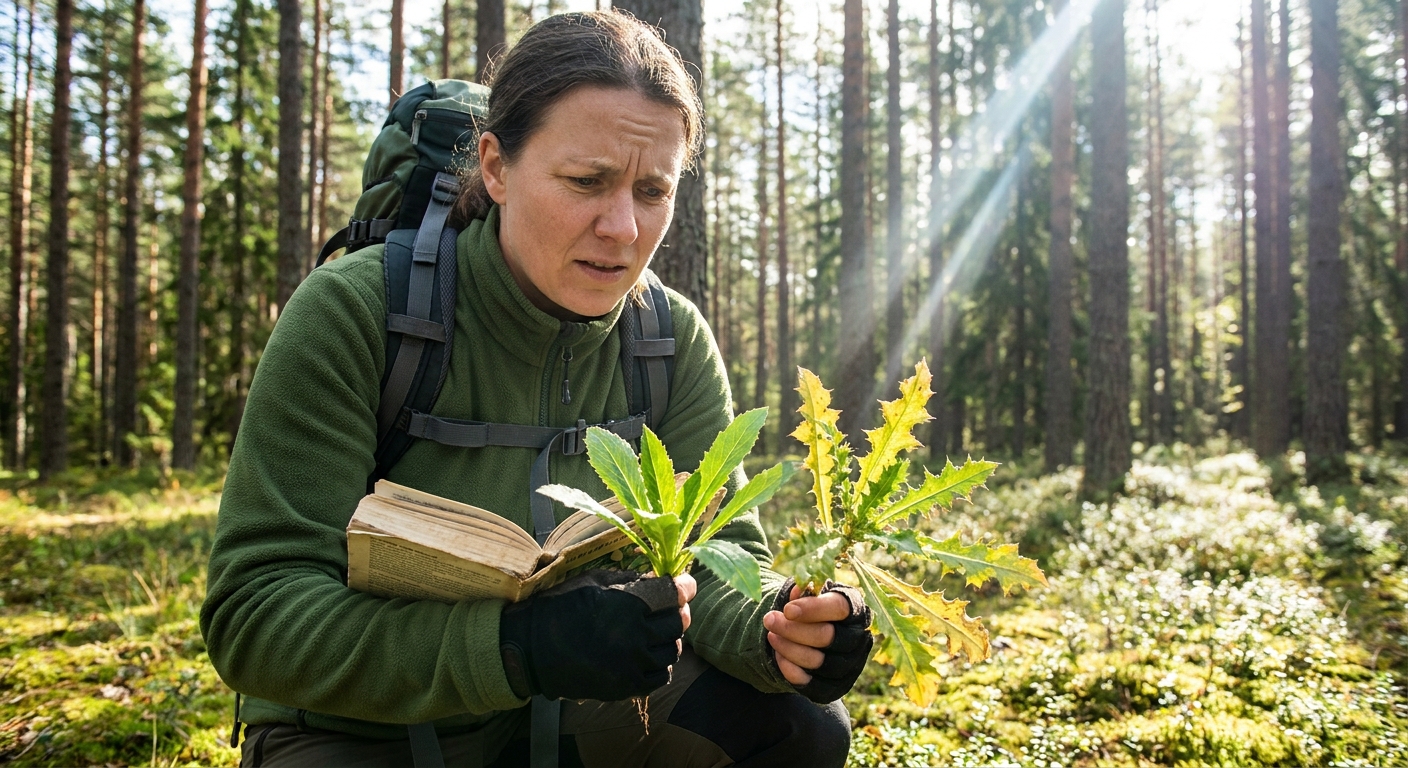
Step 3: The Look-Alike Rule—Always Ask "What Else Could It Be?"
Never stop at “This looks like X.” Your next thought must be:
“What are the most dangerous things it might also be?”
3.1. Research Likely Confusions
For any new edible you learn, also learn its most concerning look-alikes:
- Wild carrot vs. poison hemlock & water hemlock
Similar umbrella-shaped flower clusters, but hemlocks are deadly.
- Wild leeks (ramps) vs. lily-of-the-valley & false hellebore
All have broad leaves; only ramps smell like onion/garlic. Lily-of-the-valley is highly toxic.
- Elderberry vs. water hemlock/poison ivy confusions
Learn the entire shrub structure, leaf shape, and berry clusters.
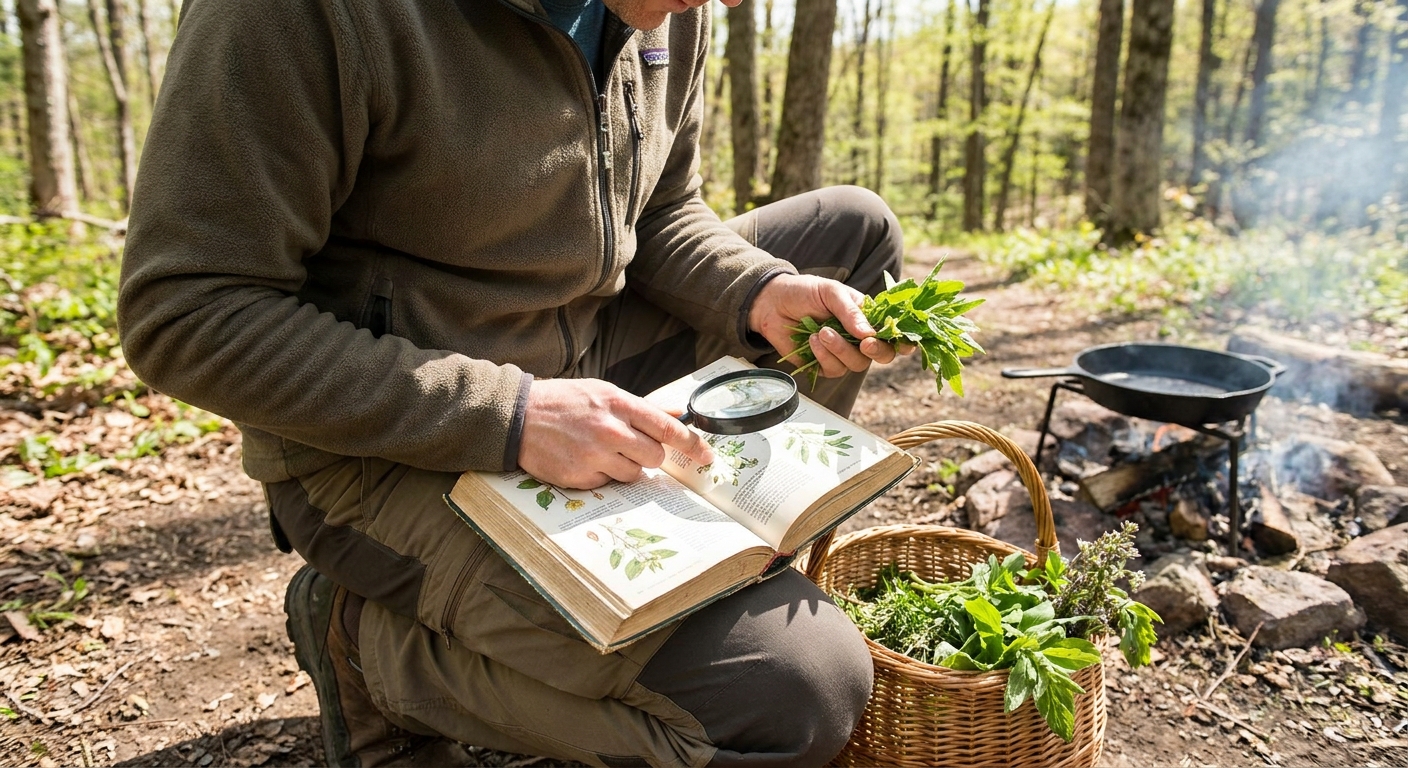
3.2. Compare Feature-by-Feature
Build a simple two-column list when you study:
- Column A: Confirmed traits of the edible plant.
- Column B: Traits of each dangerous look-alike.
- Ramp traits: Onion/garlic smell, broad leaves (usually 2–3 per plant), smooth leaf surface, white to purple stems.
- Lily-of-the-valley traits: No onion smell, leaves emerge in pairs from a single stem, bell-shaped white flowers on arching stalk later in season.
Example for ramps (Allium tricoccum):
Step 4: Engage All Your Senses—Except Taste (For Now)
4.1. Visual and Tactile Checks
- Look for consistent features across several plants in the patch.
- Feel leaf texture: is it rough, waxy, hairy, or smooth?
4.2. Smell Is a Powerful Tool
For plants known for aroma (mints, onions, resinous shrubs):
- Crush a small piece between fingers.
- Smell closely—does it match what you expect?
Warning: Do not sniff plants known for toxic sap (e.g., certain spurges) too aggressively; some can irritate mucous membranes.
4.3. The Taste Test Comes Last
Only after you have positively identified a plant, and verified it’s safe to eat raw:
- Try a piece about the size of a grain of rice.
- Hold it in your mouth for a moment, then spit it out.
- Wait 15–20 minutes. If no irritation or odd sensations, try a slightly larger piece and swallow.
This is not a substitute for proper ID—only a precaution for potential sensitivities.
Step 5: The Habitat and Season Cross-Check
Plants have preferred conditions. If the plant isn’t where or when it should be, question your ID.
5.1. Habitat Questions
- Does this wetland plant make sense on a dry hilltop?
- Does this shade-loving species actually have adequate shade here?
- Is this alpine plant suspiciously at sea level in a hot climate?
Example: Cattails (Typha spp.) should be in or right beside standing water or saturated soils. If you think you see a cattail in dry, upland soil, it’s not a cattail.
5.2. Seasonal Questions
Know basic calendars for your region:
- Spring: Tender greens (chickweed, nettles, violets, ramps).
- Summer: Berries (raspberries, blackberries, blueberries), some greens.
- Fall: Nuts (acorns, walnuts, hickories), roots, late berries.
Use local field guides or extension office calendars to cross-check.
Step 6: Quantity and Conservation
6.1. How Much to Harvest
- For robust, common species (like dandelion or lamb’s quarters): harvest no more than 20–30% of a patch.
- For slower-growing or less common natives: take far less, or observe only.
- Use clean, sharp tools to make precise cuts instead of tearing plants.
- For roots and bulbs, consider whether pulling a plant kills it—and if the patch can sustain that.
- Leave the healthiest, strongest plants to maintain the population.
6.2. Harvesting Without Harm
Step 7: Documentation and Learning from Each Forage
Treat each outing as field study.
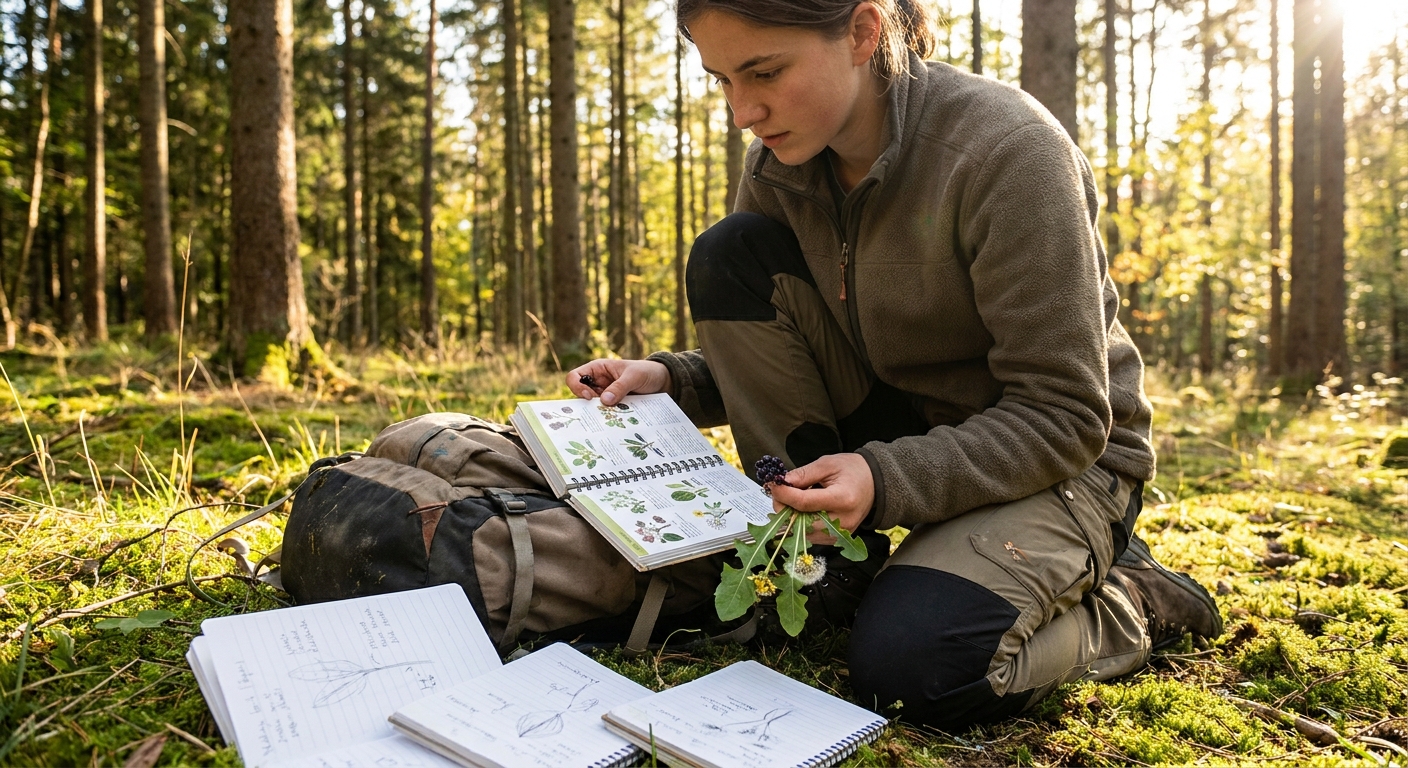
7.1. Take Notes and Photos
- Photograph plants from multiple angles: whole plant, leaf close-up, stem, flower, habitat.
- Record date, location, and habitat description.
Later, compare with field guides and reputable online resources.
7.2. Build a Personal Plant List
Create a local list with sections:
- Confidently known and used (e.g., dandelion, plantain, common berries).
- Recognized but not yet eaten (still under study).
- Avoid entirely (local toxic or protected species).
Common Pitfalls New Foragers Must Avoid
Relying on apps alone
Plant ID apps can misidentify, especially with poor lighting or partial photos. Use them as hints, not proof.
Assuming “natural” means safe
Hemlock, oleander, and death camas are all completely natural—and potentially lethal.
Eating large amounts of a new plant
Some safe edibles still cause digestive upset in quantity. Start small.
Ignoring local knowledge
Plants vary by region. Learn from local foragers, Indigenous knowledge holders, and extension services when possible.
A Mentored Mindset for Edible Plants
Think of yourself as an apprentice in a long tradition. Your job is not to prove bravery, but to develop good judgment. Apply this checklist every time you consider eating a wild plant:
- Check location and season.
- Confirm full-plant ID.
- Study and compare dangerous look-alikes.
- Use all senses cautiously, taste last.
- Verify habitat and timing.
- Harvest lightly and respectfully.
- Document and review your finds.
Over time, this methodical approach becomes second nature. When that happens, foraging stops being a gamble and becomes a grounded, deeply satisfying way to meet the edible plants that share your landscape.