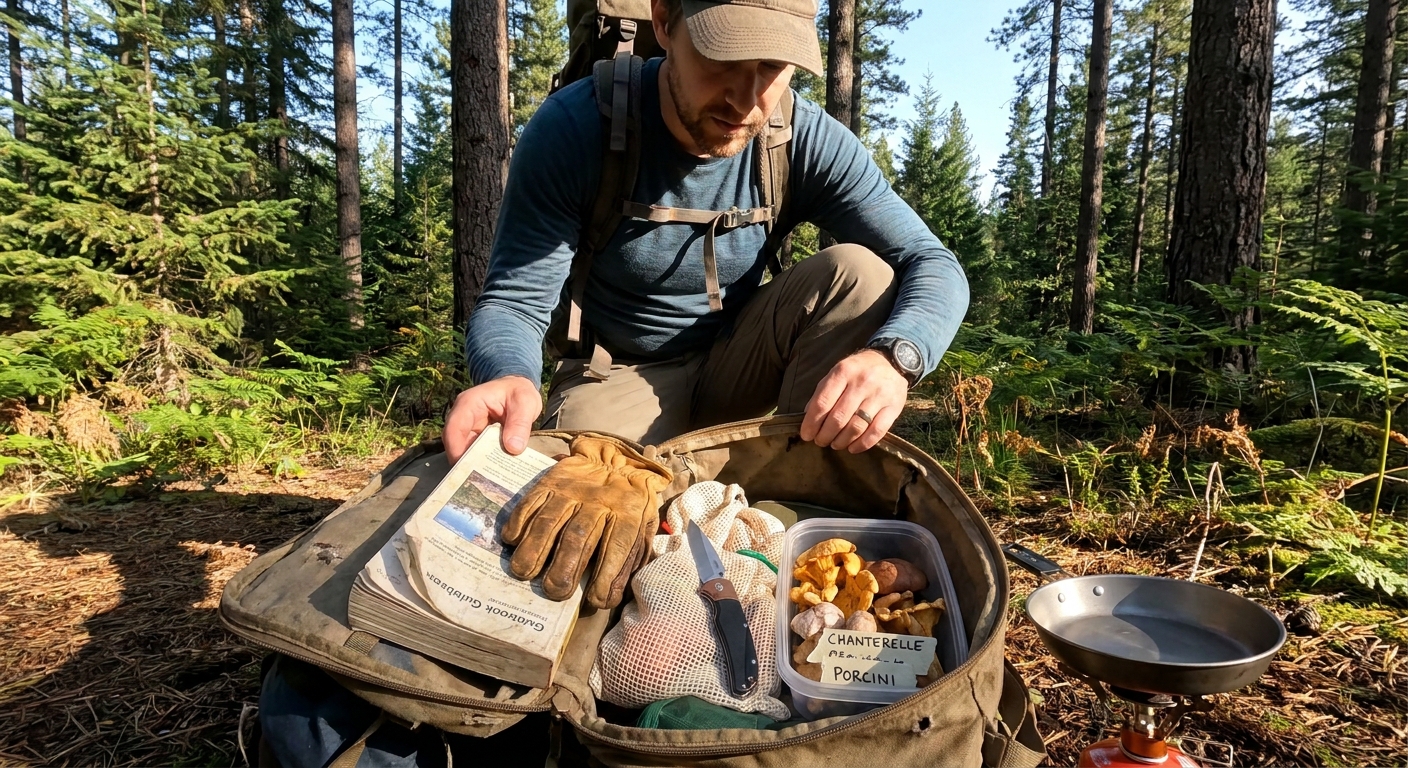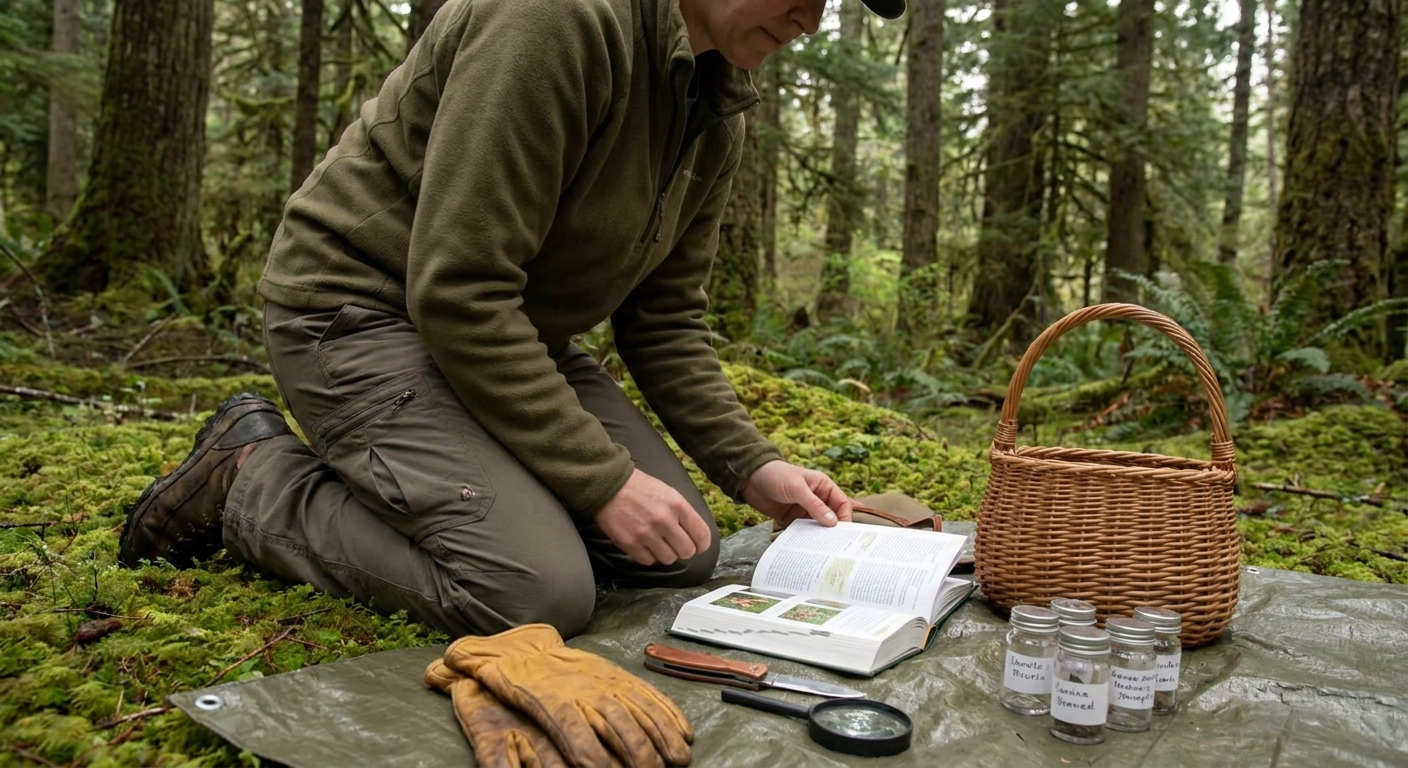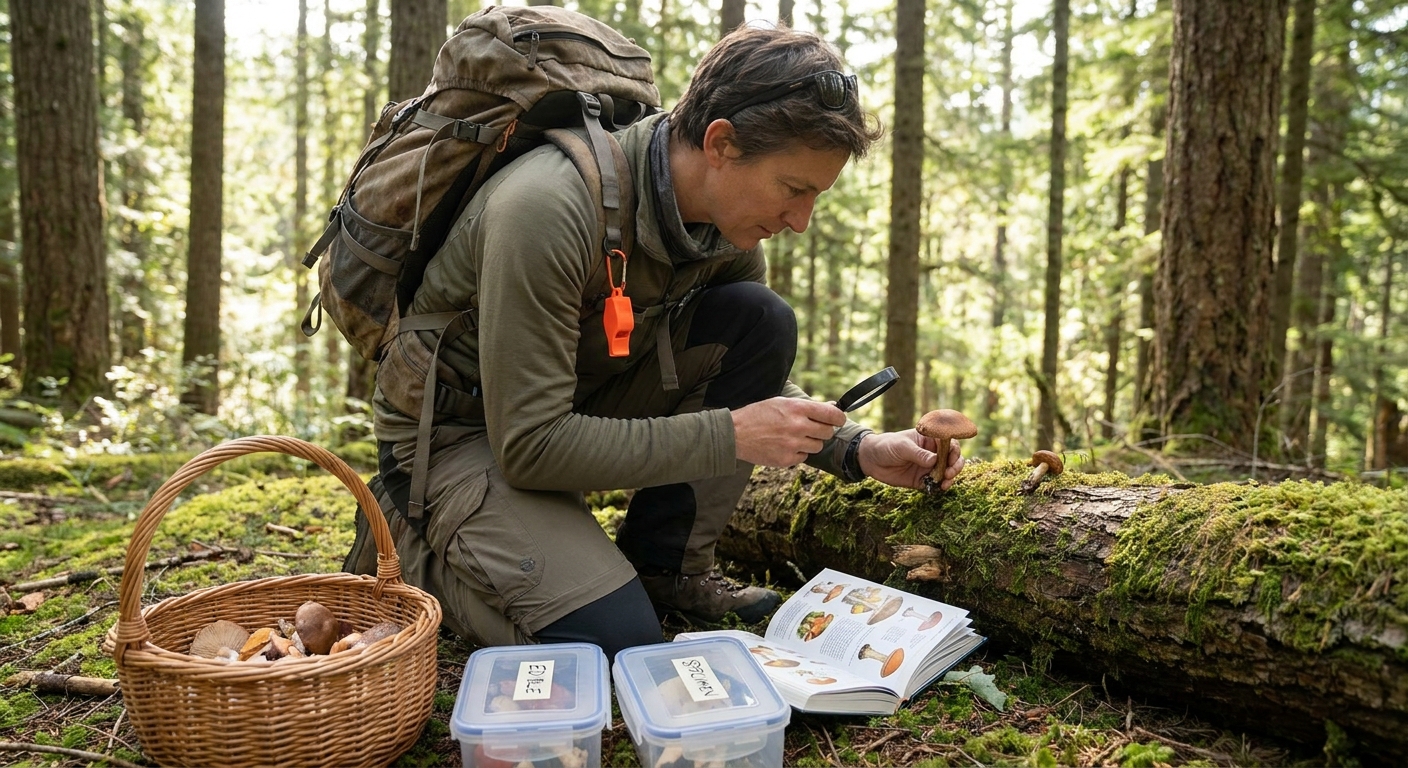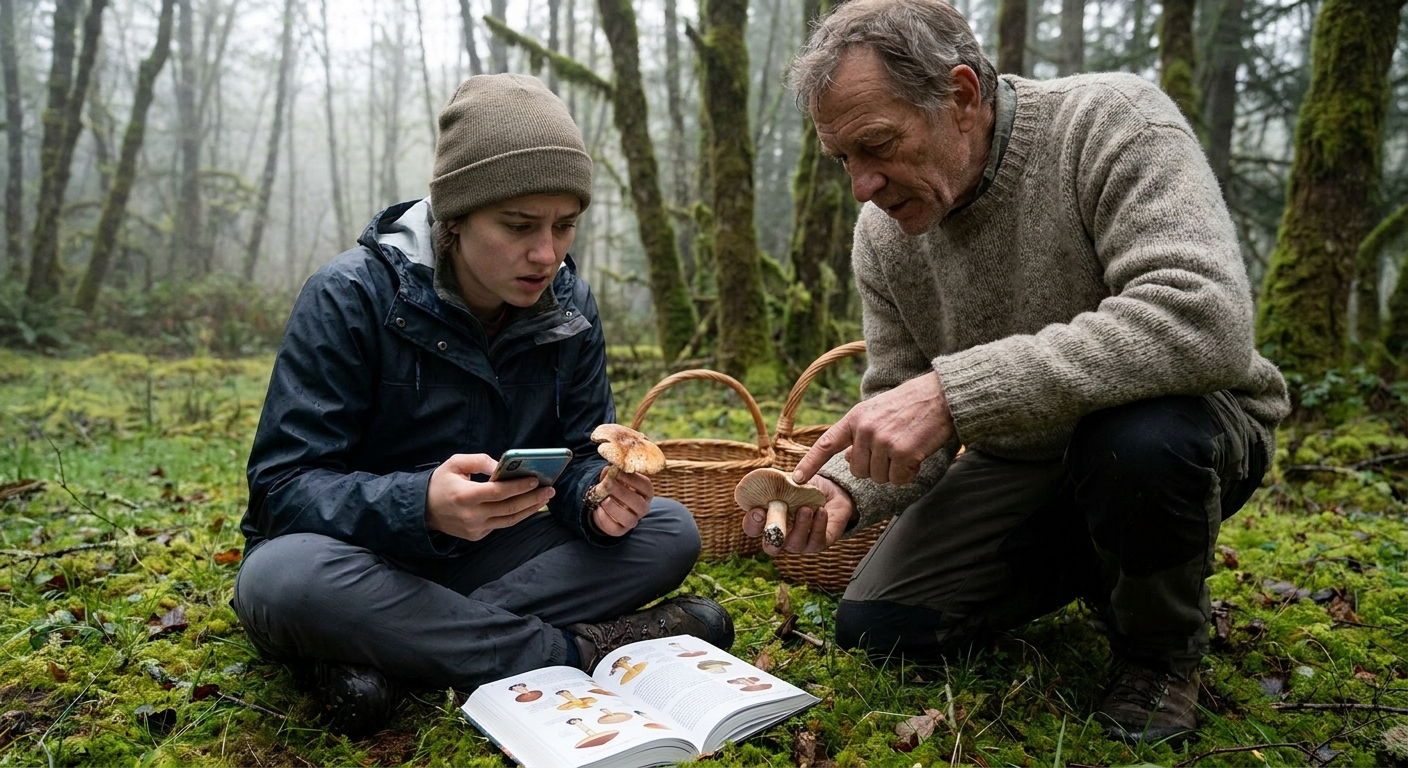
When we talk about foraging gear, we picture baskets and knives. But some of the most important tools for safety are informational: books, apps, mentors, and classes.
Not All Foraging Tools Fit in Your Pack
Choosing how you learn directly affects your risk of misidentifying species, especially where toxic look‑alikes share habitat and season with edible plants and fungi.
This guide compares three major “information tools”—field guides, phone apps, and human mentors—so you can combine them into a safer, more reliable system.
Field Guides: The Classic, Reliable Workhorse
Strengths
- Curated, peer‑reviewed information: Good guides reflect expert consensus, not crowd opinion.
- Full species profiles: Habitat, seasonality, distribution, look‑alikes, and toxicity are all in one place.
- No battery required: Works in remote habitats where cell service dies.
Weaknesses
- Can be region‑limited; a guide from another continent may mislead you.
- Photos may not cover all growth stages (e.g., young vs. mature fruiting bodies).
- Some guides oversimplify complex groups (e.g., boletes, Russulas, and umbel family plants).
Best Use Case
Field guides excel when you:
- Slowly compare multiple traits: leaf arrangement, smell, spore color, habitat, and season.
- Need a trusted baseline to check claims made by apps or friends.
Example – Using a Guide to Avoid Umbel Family Dangers
The carrot family (Apiaceae) includes both beloved edibles and deadly toxins:
- Edibles: Wild carrot (Daucus carota), some regional celery‑like species.
- Deadly: Poison hemlock (Conium maculatum), water hemlock (Cicuta spp.).
A good field guide will:
- Emphasize purple blotches and smooth stems of poison hemlock.
- Show hollow, chambered roots of water hemlock (extremely toxic).
- Warn against eating any wild umbel until you are highly experienced.
In this family, a guide is more trustworthy than any quick app result.
Phone Apps: Fast but Fallible
Strengths
- Speed: Snap a photo and get an instant suggestion.
- Accessibility: Helps beginners notice patterns and narrow down possibilities.
- Community: Some apps allow expert‑level feedback if you post detailed photos.
Weaknesses
- Error‑prone: Visual algorithms struggle with similar‑looking species.
- Often ignore habitat, smell, seasonality, and microscopic features.
- May present suggestions with unwarranted confidence, tempting risky behavior.
Best Use Case
Apps work best as:
- A starting point: “This might be a chanterelle—let’s investigate further.”
- A cross‑check against your own hypothesis, never as final proof.
Example – Chanterelles vs. Jack‑o’-Lanterns in an App
- Chanterelles: Wavy caps, blunt ridges, on soil, mycorrhizal with trees.
- Jack‑o’-lanterns (Omphalotus spp.): Sharper true gills, usually on wood, sometimes glowing faintly in the dark, cause severe GI upset.
An app may label a jack‑o’-lantern photo as “chanterelle” based on color and shape alone. Without:
- Checking the substrate (wood vs. soil)
- Feeling the gill structure
- Consulting a field guide
you could easily be misled.
Rule: If an app suggests an edible species that has known toxic look‑alikes, treat that result as hypothesis only, then verify with books, habitat inspection, and if available, a mentor.
Mentors and Classes: The Human Factor
Strengths
- Contextual teaching: Good mentors point out multiple traits simultaneously—habitat, season, smell, look‑alikes.
- Local knowledge: Specific patches, microclimates, and timing.
- Instant feedback: You can show a fresh specimen and get guidance in real time.
Weaknesses
- Quality varies: Not all self‑proclaimed experts are cautious.
- Availability: Not everyone has access to skilled instructors.
- Human memory and bias: Even experts can make mistakes.
Best Use Case
Mentors are best for:
- Learning foundational safety habits: “If in doubt, leave it out,” always check multiple traits, never eat raw unknowns.
- Getting introduced to a core set of easy, low‑risk species in your region.
Example – Learning Morels with a Mentor
A responsible mentor will show you:
- True morel characteristics: fully hollow interior, honeycomb‑like cap attached directly to the stem.
- False morel traits: lobed or brain‑like caps, chambered interiors, often toxic.
- Preferred habitats: burned areas (in some species), old orchards, or under specific trees.
They’ll also insist you:
- Cook morels thoroughly (raw morels can cause illness).
- Try only small portions when new to them.
This layered learning is harder to get from a book or app alone.
Combining Tools: Safer Together than Apart
The safest foragers treat guides, apps, and mentors as complementary gear, not competitors.
A Practical 5‑Step Workflow
Observation First
- Note habitat, associated trees, moisture, and season. - Take photos before touching the plant or mushroom.
Field Guide Check
- Use your regional guide to narrow down candidates. - Read look‑alike and toxicity sections carefully.
App as Hypothesis Generator (Optional)
- Use a photo app to propose a possible ID. - Check if its suggestion aligns with habitat, season, and field guide notes.
Mentor or Online Expert Confirmation
- If you have access to a skilled mentor, share photos and notes. - Online, use well‑moderated ID groups, following their posting guidelines: multiple angles, habitat info, spore prints for mushrooms, etc.
Edibility Decision
- Only after all four agree—your own careful assessment, field guide, app hypothesis, and expert/mentor—should you consider an edible trial. - Even then: cook thoroughly and start with a small portion.
Safety Case Studies: Which Tool Helps Most?
Case 1: Wild Garlic vs. Death Camas
- Habitat: Grassy, open areas in spring.
- Edible target: Wild garlic or onion (Allium spp.), strongly onion‑scented.
- Look‑alike: Death camas (Toxicoscordion venenosum), extremely toxic, similar leaves but no onion smell.
Best tools:
- Field guide: Emphasizes onion/garlic odor as mandatory trait.
- Mentor: Demonstrates smell test and shows plants side by side.
- App: Dangerous here if used alone—can mislabel flowers or leaves.
Case 2: Oyster Mushrooms on Hardwood Logs
- Habitat: Decaying hardwood logs, cool damp weather.
- Edible target: Oyster mushrooms (Pleurotus spp.).
- Look‑alikes: Angel wings and other white, shelf‑like fungi; some associated with illness.
Best tools:
- Field guide: Provides detailed cap, gill, and growth pattern descriptions.
- Camera: To capture host tree bark for later confirmation.
- Mentor: Can demonstrate safe vs. uncertain oyster‑like mushrooms and might advise avoiding borderline cases altogether.
Case 3: Berries along a Trail Edge
- Habitat: Sunny hedgerows, mid to late summer.
- Edible target: Blackberries (Rubus fruticosus aggregate) or raspberries.
- Look‑alikes: Some non‑edible berries (Daphne, Cotoneaster, certain honeysuckles).
Best tools:
- Field guide: Shows aggregate nature of raspberry/blackberry fruits vs. single‑seeded toxic berries.
- App: Can help a beginner notice the plant might not be a Rubus, prompting caution.
- Mentor: Teaches you to always identify the plant, not just the berry.
Building Your Personal Information Kit
A balanced, safety‑oriented information “gear” kit might include:
- At least two regional field guides (one general, one specialized for mushrooms or plants).
- A short list of trusted websites or online communities with strong moderation.
- A cautious approach to apps: they’re secondary tools, never your final authority.
- Mentoring opportunities: local mycology clubs, nature centers, or field courses.
And over all of this, carry one rule:
No single source is ever enough to eat a new wild species.
Only when your gear, guides, digital tools, and human support all point in the same direction—and you still feel confident—should you bring a new wild food to your table.