Reliable plant ID isn’t about memorizing a handful of Instagram-famous edibles. It’s learning to read the landscape: leaves, stems, flowers, habitats, and seasons all speaking a language. Once you understand that language, you’ll stop relying on “it looks right” and start using the same methods botanists and seasoned foragers trust.
Identification Is a Skill You Build, Not a Trick You Learn Once
This guide focuses on how to observe, categorize, and cross-check plants safely, with examples of what to look for and what to be wary of.
Start With Families, Not Just Species
Plants are grouped into families that share patterns. Learning these patterns makes ID faster and safer because many families have characteristic edibility or toxicity trends.
Three Families Every Forager Should Know Early
Carrot/Parsley Family (Apiaceae) – includes:
- Edibles: carrots, parsnips, fennel, some herbs. - Deadly: poison hemlock, water hemlock. - Shared traits: umbel-shaped flower clusters (like an upside-down umbrella), often hollow stems, strong scents. - Safety note: Because this family holds some of the most lethal plants, treat any wild Apiaceae as advanced-level.
Mustard Family (Brassicaceae) – includes:
- Edibles: mustards, cresses, wild radish, many spicy weeds. - Shared traits: 4 petals in a cross pattern, 6 stamens (4 tall, 2 short), seed pods below the flowers. - Few deadly members, but some can be very pungent or irritating in excess.
Nightshade Family (Solanaceae) – includes:
- Edibles: tomatoes, potatoes, eggplant, some ground cherries. - Toxic: deadly nightshade, many ornamental and wild Solanum species. - Shared traits: star-shaped flowers with central cone of fused anthers, often berry fruits. - Safety note: Unless you are very confident, avoid unknown wild nightshades.
When you encounter a new plant, ask first: “Which family does this resemble?” That alone can change how cautiously you proceed.
Key ID Features and How to Read Them
Instead of fixating on one trait (like leaf shape), learn to build a stack of clues. The more independent features you can confirm, the safer your ID.
1. Leaf Arrangement
Look at how leaves attach to the stem:
- Opposite: pairs at the same level (e.g., many mints, elderberry).
- Alternate: single leaves at staggered heights (e.g., oak, blackberry).
- Whorled: three or more leaves at the same level around the stem.
Example:
- *Elderberry (Sambucus spp.) has opposite, compound leaves.
- Pokeweed (Phytolacca americana) has alternate, simple leaves.
Confusing these two can lead to grabbing toxic pokeweed when you’re looking for elderberry. Leaf arrangement helps sort them quickly.
2. Leaf Shape and Margin
Note:
- Shape: oval, lanceolate, heart-shaped, lobed, dissected.
- Margin: smooth (entire), toothed, lobed, wavy.
Example:
- Dandelion: deeply toothed, backwards-pointing lobes.
- Plantain (Plantago spp.): broader, smoother edges, parallel veins.
Knowing these differences helps you avoid picking random “yard greens” under the assumption they’re all the same.
3. Stem Characteristics
Pay attention to:
- Cross-section: round, square, angled.
- Surface: smooth, hairy, ridged.
- Color and markings: plain green, spotted, striped.
- Internal structure: hollow or solid (only check on non-suspect species).
Examples:
- Mints (Lamiaceae): often have square stems and opposite leaves.
- Poison hemlock: smooth, hollow stems with purple blotches.
- Wild carrot: usually hairy stems without the same blotched pattern.
Remember: never break or handle heavily any plant suspected of being highly toxic (e.g., water hemlock); visual ID should come first.
4. Flowers: The Forager’s Best Friend
Flowers provide some of the most reliable clues:
- Petal count (3, 4, 5, many).
- Symmetry (radial like daisies, bilateral like peas).
- Arrangement (umbel, spike, cluster, solitary).
Examples:
- Mustard family: 4 petals, cross shape.
- Daisy family (Asteraceae): central disc florets + surrounding “petals,” which are actually ray florets.
- Pea family (Fabaceae): banner, wings, and keel petals (butterfly-like flowers).
For many plants, if you haven’t seen the flower yet, consider the ID incomplete.
5. Fruit and Seed Structures
Berries, pods, and nuts often distinguish relatives.
Examples:
- Wild grapes (Vitis spp.): clusters of true grapes, each with multiple seeds, on a vine with tendrils.
- Canada moonseed (Menispermum canadense): grape-like fruit but one crescent-shaped seed per berry and no tendrils.
Learning when to inspect the seeds can keep toxic look-alikes out of your harvest.
6. Habitat and Ecology
Where a plant grows is an ID clue:
- Wet vs. dry.
- Shade vs. full sun.
- Forest vs. field vs. disturbed ground.
- Soil type and pH (acidic pine forest vs. calcareous grassland).
Example:
- Water hemlock: nearly always in wet soils near streams, marshes, or ditches.
- Wild carrot: typically in drier fields and roadsides.
If you find a plant growing in an unlikely habitat for its supposed species, question your ID.
7. Season and Life Stage
Ask:
- Is this species known to leaf/flower/fruit now in this region?
- Are you looking at a seedling, rosette, bolting plant, or senescing remains?
Example:
- A spring rosette you think is late-summer flowering yarrow might actually be something else; wait until its normal blooming period to confirm.
Building a Safe Observation Routine
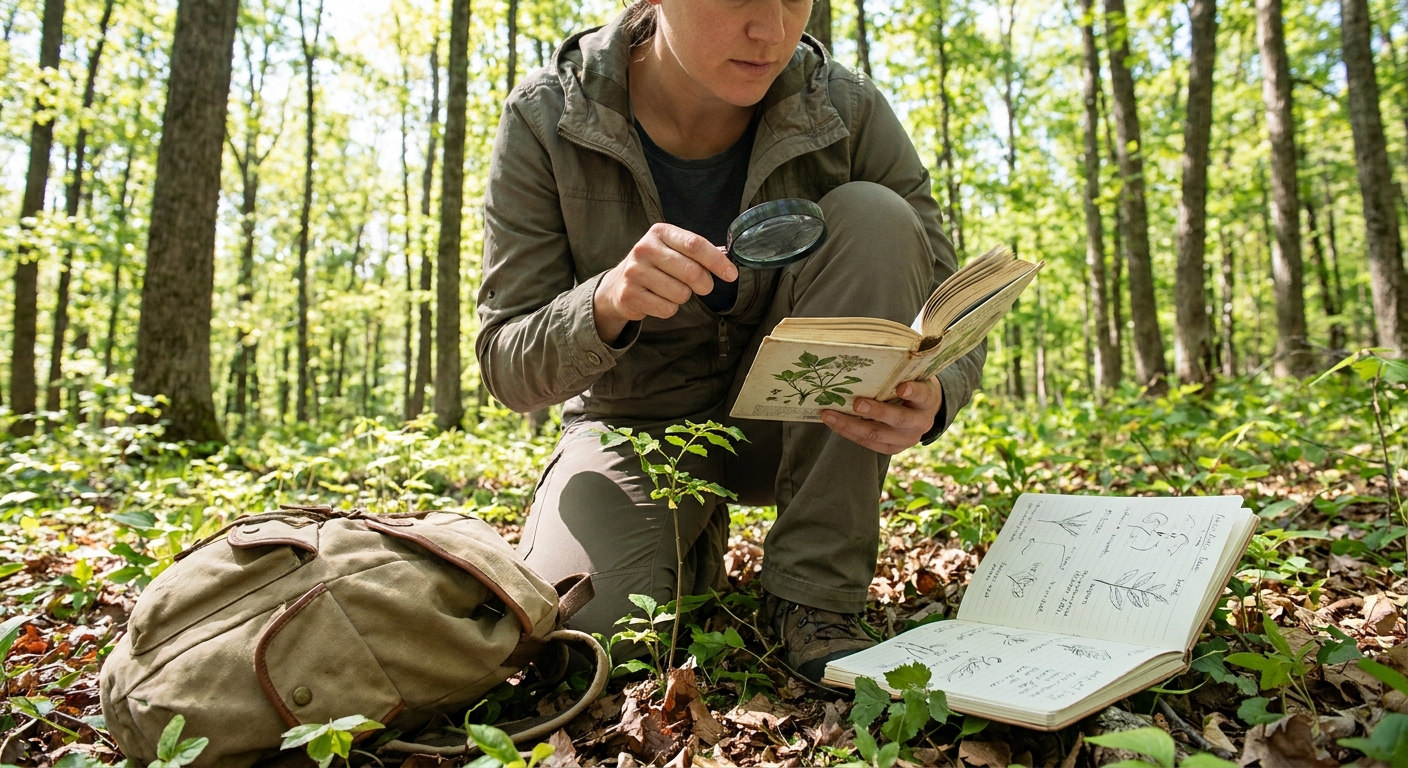
Experienced foragers often follow a mental checklist when they meet a new plant. You can formalize it in a field notebook.
Step A: Sketch or Photograph First
- Capture the plant in its whole form and close-ups.
- Include a shot of your hand for scale if helpful.
This prevents memory errors later when you compare to guides.
Step B: Write a Quick Description in the Field
Use a consistent template:
- Date, location, habitat.
- Height and growth form.
- Leaf arrangement, shape, and margin.
- Stem color and texture.
- Flower/fruit details.
- Smell (only when reasonable and safe to test).
Step C: Classify to Family Before Species
Using field guide keys or patterns you know, ask:
- “Does this look like a mustard, carrot-family, mint, pea, etc.?”
Family ID narrows your options and alerts you to family-level dangers (e.g., Apiaceae risk).
Step D: Cross-Check with Guides at Home
Compare your notes and photos to:
- A regional flora.
- A foraging-specific guide.
- At least one independent source.
Only when several independent traits align should you consider the ID reliable.
How to Handle Uncertainty Safely
Uncertainty is normal, especially in the first few years.
Rule 1: Don’t Eat “Maybe” Plants
If you find yourself thinking, “I’m pretty sure this is X,” that’s your cue to leave it in the ground.
Your categories should be:
- Confidently identified (with notes to prove it).
- Not identified yet (study-only).
There should be no “close enough” category when food is involved.
Rule 2: Use Comparison, Not Confirmation Bias
Instead of asking, “How is this similar to ___ (the edible I want it to be)?”, ask:
- “How might this be different from ___?”
- “What toxic species in my area could resemble this?”
This switch trains your brain to look for disconfirming evidence, which is how you avoid errors.
Rule 3: Ask for Help—But Don’t Outsource Responsibility
Sharing photos with local experts or plant groups is useful, but:
- Photos can miss key details (smell, texture, exact habitat, base of plant).
- Experts can disagree or misjudge from incomplete images.
Treat external opinions as additional data, not a free pass. If you can’t personally verify the ID traits, don’t eat it.
Practice: Three Example Walkthroughs
Example 1: A "Wild Carrot" in a Ditch
You see a tall plant with lacy leaves and white umbels by a ditch.
- Habitat: Wet ditch → first red flag; wild carrot prefers drier spots.
- Stem: smooth, with purple blotches → matches poison hemlock.
- Smell: unpleasant, not carrot-like.
Conclusion: Poison hemlock, not food. You walk away.
Example 2: A Backyard “Onion” Patch
Narrow leaves in clumps; you think: wild onion?
- Smell test: crush leaf—no onion/garlic scent.
- Flowers (when present): creamy star-shaped blooms.
- Habitat: open lawn.
Research suggests Death Camas is present in your region and fits these traits. You treat the whole patch as high-risk and avoid it.
Example 3: A Vining Berry in the Woods
You spot grape-like clusters.
- Leaves: simple, somewhat heart-shaped.
- Tendrils: absent.
- Seed check (after spitting out, not swallowing): single, crescent-shaped seed.
Your guide points clearly to Canada moonseed, a poisonous grape look-alike. Knowing the importance of tendrils and seed shape saved you from a bad mistake.
Turning Observation Into Intuition (Safely)
With repetition, this detailed observation process becomes second nature. You’ll glance at a plant and instantly note: opposite leaves, square stem, mint family; or compound leaves, opposite, elderberry-type shrub.
But remember: intuition without practice is just guessing. Intuition with years of structured observation behind it is experience.
To get there:
- Carry a notebook every trip.
- Make a habit of describing five plants per walk, even if you don’t plan to eat them.
- Revisit familiar spots in different seasons to see how your “known” plants change.
Safety as a Lifelong Practice
Plants don’t read field guides; they vary with soil, climate, and genetics. That’s why responsible foragers:
- Keep learning their local flora.
- Update their knowledge as they move to new regions.
- Review both edible and highly toxic* species each season.
Learn the language of plants patiently, and your confidence will be grounded in real understanding—not optimistic guesses. That’s how you earn the trust of your own senses and keep wild food a joy, not a gamble.